Showing posts with label textiles. Show all posts

Tuesday, 21 May 2013

Fix It

With much excitement, I have just discovered the Textile Toolbox
 
Textile Toolbox is the TED’s web platform project with MISTRA, that in their words is aimed at creating systemic change within the fashion industry through ‘interconnected design thinking and processes for sustainable textiles and fashion’

Stuffed with articles from the industry’s greatest thinkers across a variety of disciplines, this website is a goldmine for discovering new ideas. The articles and posts will form a basis of a report due to be published this year (so watch this space).

Below is a list of the disciplines covered on the website: 
  • Design to Minimise Waste 
  • Design for Cyclability 
  • Design to Reduce Chemical Impacts 
  • Design to Reduce Energy & Water Use 
  • Design that Explores Clean/Better Technologies 
  • Design that Looks at Models from History & Nature 
  • Design for Ethical Production 
  • Design to Reduce the Need to Consume 
  • Design to Dematerialise & Develop Systems & Services 
  • Design Activism

Swing on by, have a read and feel inspired.


Image source:Textile Toolbox

Thursday, 19 April 2012

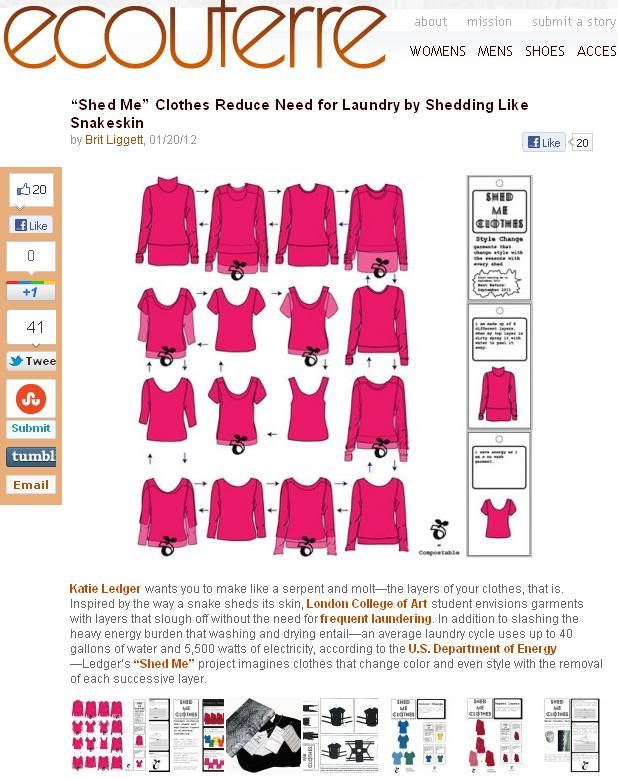
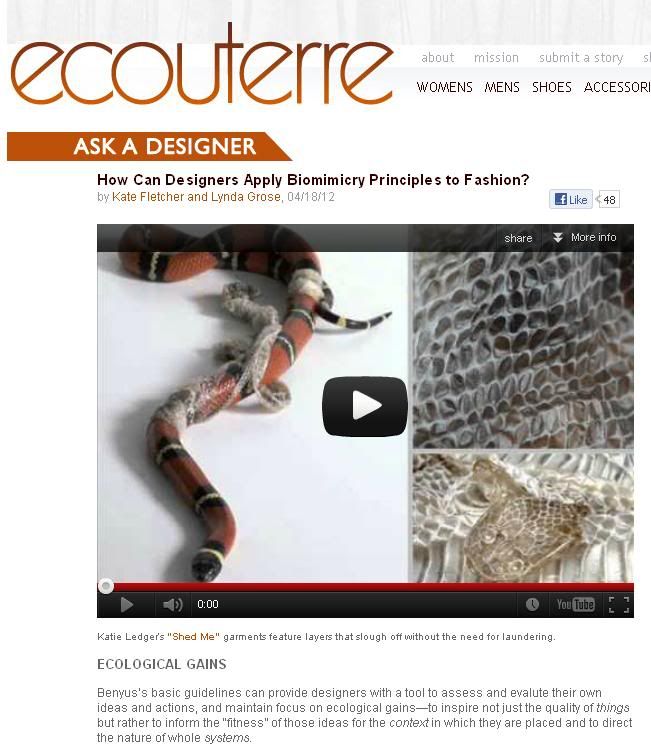
Shed me Clothes on Ecouterre

Ecouterre featured an article on my project Shed me Clothes in January which surmounted in various other blogs and websites featuring the project. I was even interviewed for the University of Arts student magazine. Below is a snapshot and link to that Ecouterre article.


Today, an extract from Kate Fletcher and Lynda Grose new book Fashion & Sustainability: Design for Change on Biomimicry was featured on Ecouterre. This article featured my Pecha Kucha video on the 2nd page:


I've checked the video on Youtube, it's now received over 1000 views. Let's just say I'm a happy bunny and a tad excited.

Saturday, 5 March 2011

New Materials for Fashion

I’ve been both a little slow in reading Shaping Sustainable Fashion as well as blogging recently. However, a forty-five minute bus journey recently gave me plenty of time to delve into the text. So far I have not come across anything overly new or innovative, mostly upcycling and fibres, which is another reason why I have not blogged.

A case study that did catch my attention was New Materials for Fashion (page 39), which discussed the potential to explore and develop new materials as possible sustainable solutions for fashion. I know exactly why I was drawn to this text; my MA Final Project was in many ways an exploration of this. Another reason would be that this research is ‘little explored in the fashion industry’. The unknown always fascinates me.

Jennifer Shellard is a textile designer who combines technology with traditional craft skills to create textiles with a colour strip that changes colour. The colour change is ‘slow and measured’ to create an ‘intriguing and meditative’ viewing experience. Her work fits into the new body of research exploring methods of engaging with consumers through transformation. Adaptive clothing has the potential to encourage a relationship or emotional response with the owner, thus reducing the need for the owner to further consume.


Shellard’s work is interesting and appears well thought out; however I feel that consumers need something more than colour change to feel connected to their clothing.

‘A central problem with fashion is that often a garment is disregarded before it ceases to function’. I totally agree. The text continues to promote the need for emotional attachment to sustain interest with the owner as being the ultimate challenge. True, but another method could be explored: to create garments that engage for a short period of time, for example the length of a trend and be safely disposed.

Fashion is and most certainly will always be fuelled by trends. We can either embrace this by searching for methods to sustain it, or turn anti-fashion and focus on maintenance and emotion. To be honest, I believe in both these methods: my own work explores the possibility of safe disposable garments that can be trend led yet there are items in my wardrobe that I have developed an emotional attachment to also. Perhaps the future will hold a happy medium for both. What do you think?

Thursday, 7 October 2010

Ethical Fashion Forum Source Expo 2010

On 06.10.2010 I attended the Ethical Fashion Forum Source Expo at Westminster City Hall. The event was in connection with the RITE conference which was taking place in the same building (of which I was too low on funds to attend).

To be honest, I hadn’t researched as to what the Expo was about; buying my ticket as student prices were a bargain at £5! Saying that I had a vague idea what the event would involve: various ethical and sustainable fashion companies promoting their products and ethics. This was pretty much the case, albeit with a seminar programme throughout the day.

Up to 64 designers, suppliers and charity/organisations were exhibiting at the event and I was impressed by my knowledge of a great deal of them.

I was keen to explore the various ethical and sustainable suppliers. I spoke to and collected information from Vericotton, Jacobs Well Oasis, The Natural Fibre Company, Mumo and One World Button Supply Company. The Vericotton representative was lovely and told me about the production of their cotton textiles, explaining that the jersey is the only jersey on the market finished with aloe vera. The jersey was incredibly soft to the touch and beautiful to look at, however when I was told the finish would wash off I wondered: ‘What’s the point?’ It suddenly became obvious that the aloe vera was a marketing ploy rather than a lifelong improvement to the durability and feel of the textile.

I was excited to see fish leather at the Mumo stand as I had previously researched the product within a project. They looked amazing and were dyed in such fabulous colours; lime green, ruby red, tangerine orange and so on. It was great to be informed that the dying process does not use chrome, instead tree bark extract. I would say the appearance is very similar to that of snake skin, however inverted (does that make sense?).

Offset Warehouse I discovered is an online directory that covers all areas of the design process to assist designers to design both ethically and sustainably. I plan to research this website further. (see www.offsetwarehouse.com to explore yourself)

I collected information about the Norman paper hangers which looked really funky and were a clearly more sustainable option that the plastic hanger. They are clearly based upon the Cradle to Cradle design approach, however were not certified Cradle to Cradle. As great as these hangers look (and believe me I want them in my wardrobe), what will become of its predecessor? I personally feel that the plastic hanger is actually rather a sustainable item as they have an incredibly long life; I must have the same hangers from my infancy (well almost)! The real issue is that when they break I have no alternative but to bin them. Surely a more sustainable alternative to creating a new product would be to create a service that will repair/recycle the existing one, i.e close the loop of the plastic hanger?

I also met and had a fantastic conversation with the designer Ada Zanditon. I am aware that Ada uses and is inspired by nature within her design work therefore was keen to chat. She told me that through patterns and shape she tries to imitate nature. A keen believer in conservation, she tries to promote this through fashion and in the meantime make people aware of the great work and lengths that people go through to conserve threatened ecosystems. We discussed biomimetic applications and she expressed an interest in my project (www.shedmeclothes.com). Ada recommended that I contact Phillips Dream Lab for funding and keep up to date with TED (which I must say I try to; its fascinating!). I was incredibly inspired by my chat with her, it made my day at the event.

I was keen to attend the ‘INNOVATION: The latest inspirational products and processes in the sustainable sourcing sector’ seminar, however found it somewhat disappointing. To be honest I didn’t think the ‘innovations’ presented were particularly innovative, expect Suzanne Lee’s Biocouture which I was already aware of. My personal definition of ‘innovation’ is ‘ground-breaking and pushing the boundaries beyond people’s perceptions’, not so much developing beads out of paper, redesigning a shoe box, fish leather, nettle and banana yarn, eco bags and paper hangers. These are just advances or ultimately the redesigning of already established products. Sure, the companies presenting offered different approaches and focused on developing communities in the process, however this is not innovation this is a human-centred or community-centred approach to business (something not limited to the fashion industry).

The Expo provided a great opportunity to discover new suppliers and designers promoting ethical and sustainable approaches to fashion as well as a platform to speak directly to potential partners. On this front I thought the event proved its purpose, however I cannot express my utter disappointment in the Ethical Fashion Forum’s interpretation of ‘innovation’ is. Innovation should amaze and excite people, ultimately making people want to explore and find out more. I felt nothing during that seminar which is a real shame.

A quick footnote of links to the companies I have mentioned:

Vericotton
Jacobs Well Oasis
The Natural Fibre Company
Mumo
One World Button Supply Company
Offset Warehouse
Norman Paper Hangers

A company that I did not mention, however was highly excited about are Toto Knits. They produce hand-made, organic cotton knitwear for children. I am desperately seeking someone I know with a child so I can buy this amazing crocodile cardigan: